
Einbürgerungstest Practice
German citizenship test practice — 460 questions, free, no signup required.
Progress is session-only — sign up free to save it.
Was bedeutet "Volkssouveränität"? Alle Staatsgewalt geht vom …
What does "popular sovereignty" mean? All state power emanates from the …
- A. the Prussian king.
- B. the Federal Constitutional Court.
- C. the people.
- D. the Bundestag.
Was ist die Bundeswehr?
What is the Bundeswehr?
- A. a German port
- B. the German police
- C. the German armed forces
- D. a German citizens' initiative
Was ist in Deutschland die "5 %-Hürde"?
What is the "5% threshold" in Germany?
- A. attendance check in the Bundestag for votes
- B. minimum share of voter votes needed to enter parliament
- C. attendance check in the Bundesrat for votes
- D. voting arrangement in the Bundestag for small parties
Was bedeutet "Rechtsstaat" in Deutschland?
What does "Rechtsstaat" (state governed by the rule of law) mean in Germany?
- A. Citizens decide on the laws.
- B. The state must comply with the laws.
- C. The state is always right.
- D. There are only right-wing parties.
Was bedeutet die Abkürzung SPD?
What does the abbreviation SPD mean?
- A. Social Policy Party of Germany
- B. Socially Just Party of Germany
- C. Socialist Party of Germany
- D. Social Democratic Party of Germany
Die Bundestagswahl in Deutschland ist die Wahl …
The Bundestag election in Germany is the election of …
- A. of the state parliaments.
- B. of the Federal President.
- C. of the Federal Chancellor.
- D. of the parliament for Germany.
Was bedeutet die Abkürzung FDP in Deutschland?
What does the abbreviation FDP mean in Germany?
- A. Free Democratic Party
- B. Leading Democratic Party
- C. Peaceful Demonstrative Party
- D. Free Germany Party
Was bedeutet "Volkssouveränität"?
What does "popular sovereignty" mean?
- A. The Federal Constitutional Court stands above the constitution.
- B. Interest groups exercise sovereignty together with the government.
- C. State power emanates from the people.
- D. The king/queen rules over the people.
In einer Demokratie ist eine Funktion von regelmäßigen Wahlen, …
In a democracy, one function of regular elections is …
- A. to maintain existing laws in the country.
- B. to give more power to the poor.
- C. to force citizens to cast their vote.
- D. to allow the government to change according to the will of the voter majority.
Welches Gericht in Deutschland ist zuständig für die Auslegung des Grundgesetzes?
Which court in Germany is responsible for interpreting the Basic Law?
- A. Federal Constitutional Court
- B. Administrative Court
- C. Higher Regional Court
- D. Local Court
Was bekommen wahlberechtigte Bürgerinnen und Bürger in Deutschland vor einer Wahl?
What do eligible citizens in Germany receive before an election?
- A. a notification from the Federal Convention
- B. a notification from the parish office
- C. a polling card from the municipality
- D. voting permission from the Federal President
Welche Handlungen mit Bezug auf den Staat Israel sind in Deutschland verboten?
Which actions related to the state of Israel are prohibited in Germany?
- A. publicly criticizing Israel's policies
- B. hanging an Israeli flag on private property
- C. publicly calling for the destruction of Israel
- D. discussing Israel's policies
Wer wählt die Bundeskanzlerin/den Bundeskanzler in Deutschland?
Who elects the Federal Chancellor in Germany?
- A. the people
- B. the Bundesrat
- C. the Bundestag
- D. the Federal Convention
Warum gibt es die 5 %-Hürde im Wahlgesetz der Bundesrepublik Deutschland? Es gibt sie, weil …
Why does the 5% threshold exist in the electoral law of the Federal Republic of Germany? It exists because …
- A. many small parties make forming a government more difficult.
- B. small parties don't have enough money to pay politicians.
- C. the programs of many small parties have a lot in common.
- D. citizens can lose orientation with many small parties.
Wer leitet das deutsche Bundeskabinett?
Who leads the German federal cabinet?
- A. the Federal President
- B. the President of the Bundesrat
- C. the Federal Chancellor
- D. the President of the Bundestag
Parlamentsmitglieder, die von den Bürgerinnen und Bürgern gewählt werden, nennt man …
Members of parliament who are elected by citizens are called …
- A. ambassadors.
- B. minister-presidents.
- C. members of parliament (deputies).
- D. chancellors.
Wer wählt die deutsche Bundeskanzlerin/den deutschen Bundeskanzler?
Who elects the German Federal Chancellor?
- A. the Federal Convention
- B. the federal government
- C. the people
- D. the Bundestag
Vom Volk gewählt wird in Deutschland …
In Germany, who is elected by the people?
- A. the Federal President
- B. the Bundestag
- C. the minister-president of a federal state
- D. the Federal Chancellor
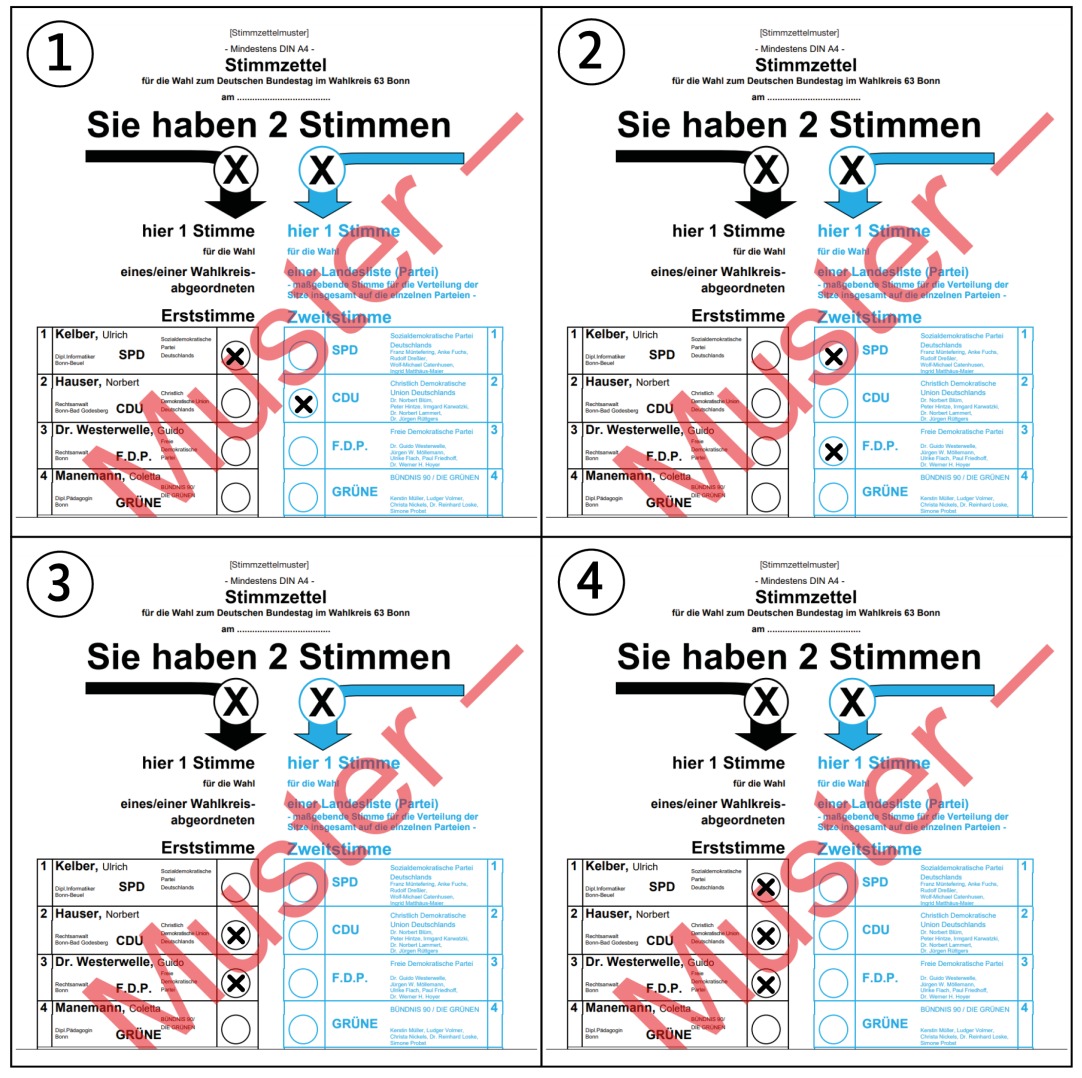
Welcher Stimmzettel wäre bei einer Bundestagswahl gültig?
Which ballot paper would be valid in a Bundestag election?
- A. 1
- B. 2
- C. 3
- D. 4
Was ist bei Bundestags- und Landtagswahlen in Deutschland erlaubt?
What is permitted in Bundestag and state parliament elections in Germany?
- A. One can cast their vote by postal ballot.
- B. One can cast their vote by phone on election day.
- C. Children from the age of 14 are allowed to vote.
- D. The husband votes on behalf of his wife as well.
Naturalization also requires B1 German. Our free B1 course gets you there.