
German tenses: all 6 explained
German has six tense forms, but you do not use all six equally. Präsens and Präteritum are simple tenses built from the verb itself. Perfekt, Plusquamperfekt, Futur I, and Futur II are compound forms built with auxiliary verbs. The useful part is knowing not just how each tense is formed, but when German speakers actually choose it.
Why German tenses feel different — and why they shouldn't
German is often described as having six tenses, which sounds daunting. (For the underlying verb forms and conjugation patterns, start there.) The trick is recognising that only two of them — Präsens and Präteritum — are simple tenses. In a simple tense you just conjugate the main verb: "er lernt" (Präsens), "er lernte" (Präteritum). Done.
The other four are compound tenses. They combine one or more auxiliary verbs with an infinitive or past participle. Perfekt, Plusquamperfekt, and Futur I have two main verb components; Futur II is the three-verb outlier: er wird gelernt haben.
er lernt
er lernte
er hat gelernt
er hatte gelernt
er wird lernen
er wird gelernt haben
Notice the pattern: Perfekt and Plusquamperfekt use haben or sein, while Futur I and Futur II use werden. The infinitive or participle moves toward the end of the clause, and Futur II adds a final haben or sein: er wird gelernt haben.
German tenses chart: all 6 at a glance
Compare the formation, example, typical use, and learner level of all six German tenses.
| Tense | Structure | Example | When to use | Level |
|---|---|---|---|---|
| Präsens | Verb stem + ending | Ich lerne Deutsch. | Present, habits, facts, and common future plans | A1 |
| Perfekt | haben/sein + Partizip II | Ich habe Deutsch gelernt. | Most everyday spoken past situations | A1 |
| Präteritum | Präteritum verb form | Ich lernte Deutsch. | Narrative and written past; also common with some verbs in speech | A2 |
| Plusquamperfekt | hatte/war + Partizip II | Ich hatte Deutsch gelernt. | An event that happened before another past event | B1+ |
| Futur I | werden + Infinitiv | Ich werde Deutsch lernen. | Predictions, intentions, promises, or emphasized future | A2/B1 |
| Futur II | werden + Partizip II + haben/sein | Ich werde Deutsch gelernt haben. | Something completed by a future point; assumptions about the past | B1/B2 |
You may also see these called: Präteritum — simple past, preterite, or Imperfekt; Futur I — Futur 1; Futur II — Futur 2.
Which German tense should I use?
The right tense usually depends on two things: when the event happens and how you are talking about it. These rules cover most everyday choices.
Present, habits, and facts — Präsens
Use Präsens for something happening now, something you do regularly, or something generally true.
Ich lerne Deutsch. I am learning German.
Normal spoken past — usually Perfekt
In everyday conversation, Perfekt is the safest default for most completed past events.
Ich habe das gemacht. I did that.
Wir sind nach München gefahren. We went to Munich.
sein, haben, and modal verbs are especially common in Präteritum in speech: war, hatte, konnte, musste, wollte, sollte, durfte.
Story or narrative — usually Präteritum
When writing a narrative, Präteritum is the usual past tense. Keep the narrative past consistent: forms such as ging, sagte, war, and hatte naturally belong together.
Er öffnete die Tür und ging hinein. He opened the door and went inside.
Before another past event — Plusquamperfekt
Use Plusquamperfekt when one past event had already happened before another past event.
Sie war schon gegangen, als er ankam. She had already left when he arrived.
It often appears with words such as nachdem, als, bevor, schon, bereits, or vorher, but nachdem is not required.
Normal future plan — often Präsens
If the future is already clear from a time expression, German often uses Präsens instead of Futur I.
Ich komme morgen. I am coming tomorrow.
Wir fliegen nächste Woche nach Rom. We are flying to Rome next week.
Prediction, intention, or promise — Futur I
Use Futur I when the future itself is being emphasized, especially for predictions, intentions, and promises.
Es wird morgen regnen. It will rain tomorrow.
Ich werde dir helfen. I will help you.
Completed by a future point — Futur II
Use Futur II when something will already be completed by a future reference point.
Bis Freitag werde ich den Bericht fertiggestellt haben. By Friday, I will have finished the report.
Futur II can also express an assumption about something that has probably already happened: Er wird das vergessen haben.
The German tense system on one timeline
Perfekt and Präteritum usually describe the same broad past time but differ in how they are used. Plusquamperfekt moves further back into the past, while Präsens extends into many everyday future situations.
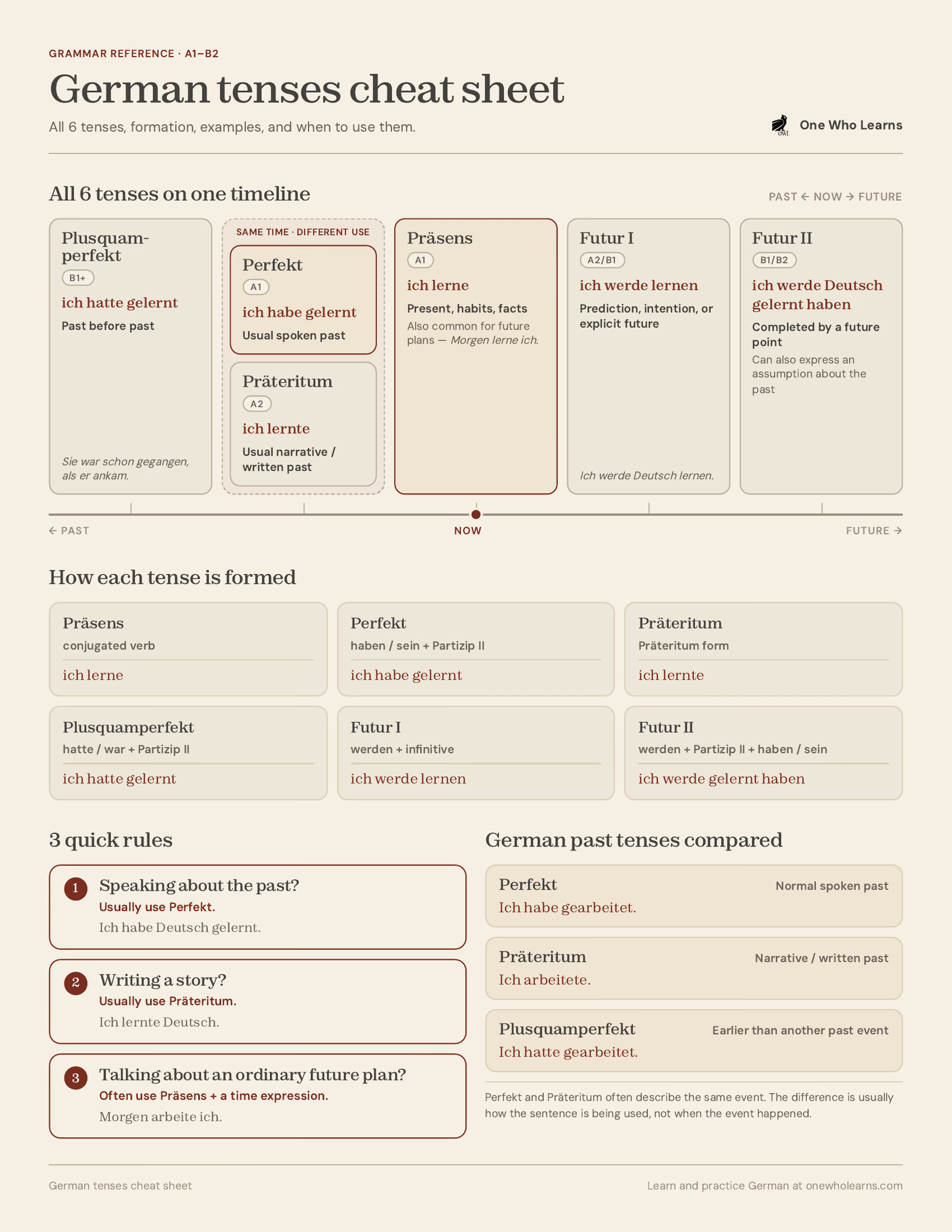
One sentence in all 6 German tenses
Using the same verb makes the structure of the six tenses easier to see.
- Präsens Ich lerne Deutsch.
- Perfekt Ich habe Deutsch gelernt.
- Präteritum Ich lernte Deutsch.
- Plusquamperfekt Ich hatte Deutsch gelernt.
- Futur I Ich werde Deutsch lernen.
- Futur II Ich werde Deutsch gelernt haben.
Free printable
German tenses cheat sheet PDF
Download all 6 German tenses on one printable page, with formation rules, example sentences, and a quick guide to when each tense is used.
Each tense, explained
Formation, examples, and the main use of each tense — with links to the detailed guides.
Präsens
Present tensePräsens covers present actions, habits, facts, and many ordinary future plans. German also uses Präsens where English often uses a progressive form: both “he works” and “he is working” can be er arbeitet.
Verb stem + personal ending (-e, -st, -t, -en, -t, -en)
- Ich lerne jeden Tag Deutsch. I learn German every day.
- Morgen fahre ich nach Berlin. I'm going to Berlin tomorrow.
Perfekt
Conversational pastPerfekt is the default past tense for most everyday conversation. It is formed with haben or sein plus a past participle. For A1–A2 learners, this is the most useful tense for talking about completed past events.
haben/sein (present) + Partizip II
- Ich habe das Buch gelesen. I read the book.
- Sie ist nach Hause gegangen. She went home.
Präteritum
Simple past / preteritePräteritum is common in narrative and written German, including stories, reports, and many news texts. In everyday speech, most verbs usually appear in Perfekt instead, while sein, haben, and modal verbs are especially common in Präteritum: war, hatte, konnte, musste, wollte, sollte, and durfte.
Verb stem + Präteritum ending (-te/-ete for weak; vowel change for strong)
- Er war gestern müde. He was tired yesterday.
- Die Reise dauerte drei Stunden. The journey took three hours.
Plusquamperfekt
Past perfectPlusquamperfekt expresses an event that happened before another past event — the German equivalent of “had done.” It often appears with words such as nachdem, als, bevor, schon, bereits, or vorher, but the real rule is simply past before past.
haben/sein (Präteritum) + Partizip II
- Nachdem ich gegessen hatte, schlief ich ein. After I had eaten, I fell asleep.
- Sie war schon gegangen, als er ankam. She had already left when he arrived.
Futur I
Future IFutur I expresses predictions, intentions, promises, and deliberately emphasized future events. For ordinary plans with a clear time expression, Präsens is usually more natural: Ich komme morgen is more typical than Ich werde morgen kommen.
werden (present) + Infinitiv
- Es wird morgen regnen. It's going to rain tomorrow. (prediction)
- Ich werde das erledigen. I will take care of that. (promise)
Futur II
Future II / Future perfectFutur II expresses something that will be completed by a future point, or an assumption about something that has probably already happened. It is relatively uncommon in everyday German, so learners can safely study it after the more frequent tenses.
werden (present) + Partizip II + haben/sein
- Bis morgen werde ich alles vorbereitet haben. By tomorrow, I will have prepared everything.
- Er wird das wohl vergessen haben. He has probably forgotten that.
- Sie wird schon angekommen sein. She has probably arrived by now.
German past tenses compared: Perfekt, Präteritum, and Plusquamperfekt
German has three important ways to talk about past events. Perfekt and Präteritum often describe the same event but differ mainly in register and context. Plusquamperfekt moves one step further back and describes something that had already happened before another past event.
Perfekt, Präteritum, and Plusquamperfekt
Three ways to place an event in the past — two of them at the same point in time.
The usual choice for completed past events in everyday conversation.
Example
Ich habe gestern einen Film gesehen.
I watched a film yesterday.
Common when telling a story in writing and in many reports, novels, and news texts.
Example
Er öffnete die Tür und trat ein.
He opened the door and stepped inside.
Shows that one past event had already happened before another.
Example
Sie war schon gegangen, als er ankam.
She had already left when he arrived.
German vs English tenses
German and English do not map tense-for-tense. German often uses context and time expressions where English uses a separate progressive or future form.
| English | Natural German |
|---|---|
| I work. | Ich arbeite. |
| I am working. | Ich arbeite. |
| I worked. | Ich habe gearbeitet. / Ich arbeitete. depending on context |
| I am going tomorrow. | Ich gehe morgen. |
| I will go tomorrow. | Often Ich gehe morgen.; Ich werde morgen gehen. adds stronger future emphasis |
| I will have finished by Friday. | Bis Freitag werde ich fertig sein. — or a Futur II form when the completion itself needs emphasis |
The biggest difference for English-speaking learners is that German has no separate grammatical progressive tense. Ich arbeite can mean both “I work” and “I am working,” depending on context.
haben vs. sein: the auxiliary selection rule
When forming Perfekt or Plusquamperfekt, you must pick between haben and sein as your auxiliary. The rule: most verbs take haben. Switch to sein only for the three verb categories below.
sein auxiliary
Motion (change of location), change of state, plus bleiben and sein itself
- gehen — ist gegangen to go → has gone
- kommen — ist gekommen to come → has come
- werden — ist geworden to become → has become
- aufwachen — ist aufgewacht to wake up → has woken up
- bleiben — ist geblieben to stay → has stayed
- sein — ist gewesen to be → has been
haben auxiliary
All other verbs — transitive, most intransitive, mental state, activity verbs
- machen — hat gemacht to do/make → has done
- sehen — hat gesehen to see → has seen
- haben — hat gehabt to have → has had
- essen — hat gegessen to eat → has eaten
- lernen — hat gelernt to learn → has learned
- schlafen — hat geschlafen to sleep → has slept
Can you choose the right German tense?
Choose the form that fits the context. The goal is not just conjugation — it is knowing which tense a German speaker would naturally choose.
Practice German verb conjugation
Drill Präsens, Präteritum, and Perfekt with real German verbs and instant feedback.
Which tense to learn first: the A1→B1 path
You do not need all six tenses at once. Here is the recommended order for German learners.
- A1
Start with Präsens
Learn Präsens first for present actions, habits, facts, and ordinary future plans. It is the tense you will use most often as a beginner.
- A1–A2
Add Perfekt for spoken past
Learn haben vs. sein and the most common past participles. Perfekt lets you talk naturally about what you did, saw, ate, learned, and experienced.
- A2
Learn the Präteritum of key verbs
Start with the Präteritum forms you will hear most often in everyday speech: war (sein), hatte (haben), and the modal forms konnte, musste, wollte, sollte, and durfte. You will also encounter wurde frequently, but do not treat werden as a universal exception to Perfekt.
- A2–B1
Complete Präteritum for reading
Once you start reading German texts, you need the full Präteritum system: weak endings (-te), strong vowel changes (ablaut), and the irregular stems. This is passive recognition first — active production comes with practice.
- B1–B2
Plusquamperfekt, Futur I, Futur II
Add Plusquamperfekt once you can comfortably talk about the past, then learn Futur I for explicit future meaning. Futur II is less frequent and can come last. You do not need all six tenses equally well to communicate naturally.